
Market insight
Nigeria, Kenya, South Africa: Truck Import Duty and Clearance Cost Comparison
The same USD 50,000 CIF truck faces very different tax bills in Nigeria, Kenya, and South Africa. This guide compares tax bases, duties, and clearance.
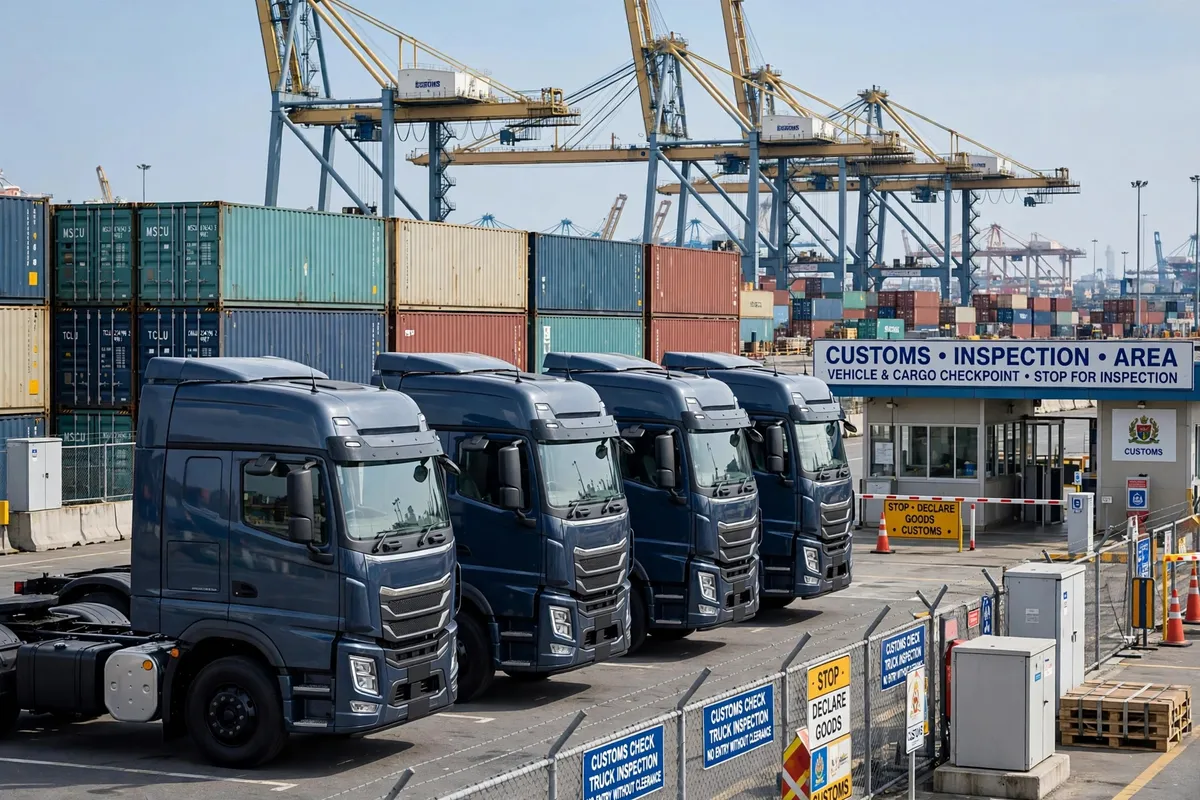
Many African buyers compare only the truck price and freight, and discover too late that duties and clearance charges are the most variable part of landed cost. The same brand-new truck at USD 50,000 CIF can attract a total tax bill approaching 90% of its CIF value in Kenya, around 35% in Nigeria, and a middle figure in South Africa depending on the ad valorem band. This guide compares Nigeria, Kenya, and South Africa — three major markets for Chinese trucks — on tax base, duty structure, and clearance process. One caveat first: rates change frequently, and the figures below reflect commonly published ranges for scale comparison only. The final assessment is always the destination customs authority's.
Start with the Tax Base: CIF or FOB
Kenya and Nigeria assess duties on the CIF value (cost plus insurance plus freight) — higher freight means a bigger tax base. South Africa differs: customs duty is charged on the FOB value (excluding freight and insurance), while import VAT is charged on an Added Tax Value equal to the FOB value uplifted by 10%, plus duty payable. The difference matters: on a South Africa-bound shipment, ocean freight itself does not attract duty, though the VAT calculation still pulls part of the freight factor back in. Never compare headline rates without comparing the base.
Kenya: Most Tax Layers, Highest Total Burden
Kenya belongs to the East African Community customs union and applies the Common External Tariff. For trucks (HS 8704), the commonly published import duty is 25% of CIF, with a 10% band for construction and agricultural vehicles. On top of duty comes excise duty: diesel vehicles are banded by engine size, commonly 20% to 35%, on the base of CIF plus duty. Then come the Import Declaration Fee and Railway Development Levy, together around 4% of CIF. Finally, 16% VAT applies to the sum of everything before it.
Two Kenyan systems deserve special attention. First, customs valuation: the Kenya Revenue Authority does not simply accept the invoice price. It works from the CRSP (Current Retail Selling Price) reference schedule, derives a customs value after age depreciation, and taxes whichever is higher — the declared CIF or the CRSP-derived value. Second, the age limit: under the Kenya Bureau of Standards code KS 1515:2000, used vehicles may not exceed 8 years from first registration, and from 2026 only right-hand-drive units first registered on or after 1 January 2019 may enter, subject to roadworthiness inspection and certification. Roughly calculated, a new truck at USD 50,000 CIF — 25% duty, 25% excise, about 4.5% in IDF and RDL, and 16% VAT stacked on top — carries a total tax bill of about USD 43,000, roughly 86% of CIF. Kenya is the heaviest-tax market of the three, and its tax must be budgeted before purchase, not discovered at the port.
Nigeria: Low Headline Duty, Many Add-Ons
Nigeria's basic duty for commercial vehicles is commonly published at 10% of CIF — but that is only the starting point. Added on top are the National Automotive Council levy of 15%, a 7% surcharge, the 0.5% ECOWAS Trade Liberalization Scheme levy, and 7.5% VAT on the accumulated total. For an HS 8704 dump truck, published estimates put the total landed tax rate at roughly 32% to 38% of CIF.
Nigeria's clearance paperwork is the most demanding of the three. Importers must file Form M (an import declaration lodged with the Central Bank) before shipment, obtain a SONCAP certificate (Standards Organisation of Nigeria conformity assessment), and clear against a PAAR (Pre-Arrival Assessment Report), followed by a joint physical inspection by Customs and Standards officials verifying chassis numbers, engine numbers, and vehicle condition against the certificates. Missing documents or mismatched chassis numbers are the most common cause of detention at Lagos ports, where storage charges accrue daily — two weeks of delay is real money. Roughly calculated, the same USD 50,000 CIF truck faces about USD 17,000 to 19,000 in total Nigerian taxes — roughly half of Kenya's — but with higher clearance time and documentation costs.
South Africa: Low Barrier for New Trucks, Strict Control on Used Ones
South Africa's duty structure is comparatively simple: vehicle import duty is commonly published at about 20% to 25% on the FOB value; import VAT is 15% on the FOB value uplifted by 10% plus duty; and an ad valorem excise duty applies on a sliding scale by customs value, with higher values in higher bands. Roughly calculated, a truck at USD 45,000 FOB faces about USD 20,000 in duty plus VAT, around 40% of the CIF equivalent, before the ad valorem band effect.
The real South African barrier is not the rate but import control. New vehicles — including new trucks, tractors, and buses — are not subject to import quantity control and enter on payment of duties. Used vehicles are entirely different: the International Trade Administration Commission (ITAC) issues import permits only in defined circumstances, mainly returning South African nationals and permanent-residence immigrants importing vehicles registered in their own names. Commercial import of used vehicles for resale is generally not permitted. In addition, every imported vehicle needs a Letter of Authority from the National Regulator for Compulsory Specifications (NRCS) and must pass a compliance inspection on arrival at Durban — non-compliant vehicles sit in port at the importer's cost and can be ordered re-exported. For Chinese exporters, South Africa is a new-truck market; the used-truck business there is not worth gambling on.
Tanzania and Ghana: Same Frameworks, Confirm the Details
Tanzania belongs to the East African Community alongside Kenya, so it operates under the same Common External Tariff framework: a CIF-based, multi-layer calculation cleared through Dar es Salaam. Ghana belongs to the ECOWAS community alongside Nigeria, with a similar CET-plus-VAT-plus-levy logic. Specific bands, port charges, and inspection requirements in both countries change quickly, so this guide gives no figures for them — instead, ask a licensed clearing agent at the destination port for a written, model-specific tax estimate before signing, and attach it to the contract.
The Worked Comparison: One Truck, Three Countries
Take a brand-new diesel truck at USD 50,000 CIF (about USD 45,000 FOB for the South African calculation). Rough totals:
| Country | Total tax | Landed cost | Notes |
|---|---|---|---|
| Kenya | about USD 43,000 | about USD 93,000 | taxes heaviest but runs a transparent process |
| Nigeria | about USD 17,000 to 19,000 | about USD 67,000 to 69,000 | taxes lighter but grinds on paperwork and clearance time |
| South Africa | about USD 20,000 in duty plus VAT (before ad valorem band differences) | around USD 70,000 | sits in the middle but only works for new trucks |
The lesson is plain: Kenya taxes heaviest but runs a transparent process; Nigeria taxes lighter but grinds on paperwork and clearance time; South Africa sits in the middle but only works for new trucks. Choosing a market is never just about the rate — it is about clearance difficulty, payment cycles, and after-sales coverage too.
Four Ways to Save Money and Avoid Trouble
- HS classification sets the rate: tractors, dump trucks, tankers, and cargo trucks carry different codes, and a wrong classification can mean back taxes and fines — have the clearing agent confirm the code before signing.
- do not skip the certificate of origin: a Chinese certificate of origin can affect rates under preferential arrangements and, even without a preference, reduces customs queries.
- invoice honestly: under-invoicing is largely useless against Kenya's CRSP system and Nigeria's customs valuation, and it invites inspection.
- start clearance preparation two months early: Nigeria's Form M and SONCAP, Kenya's inspection booking, and South Africa's NRCS letter of authority all need to be in hand before shipment — starting after the vessel arrives lets port storage eat every margin.
Duty is not a footnote to cost. It is the first number to calculate when choosing a model, a market, and payment terms.
Country rules sit inside a bigger buy flow — see 5 Buyer Questions When Importing Chinese Heavy Trucks to Africa. For RHD markets (Kenya / South Africa), read Right-Hand-Drive Truck Buying Guide. Payment method affects landed cost: TT, LC, or Installments. Process overview: How to Order a Chinese Heavy Truck in 7 Steps. Browse trucks.
References
[1] CalcKenya, "Vehicle Import Taxes Calculator"
[2] Shengchi Truck, "Import duty and taxes for trucks from China to Kenya"
[3] Cavendish Auto, ["Auto Logistics & Car Import Clearance Nigeria"]
(https://cavendishauto.com/services/logistics)
[4] Ahcarsale, "Car Import Tax in Nigeria: What Buyers Must Know"
[5] Shengchi Truck, "How to import dump trucks from China to Nigeria"
[6] ShipCars, ["Shipping a Truck to Durban 2026: ITAC & Duty Guide"]
(https://www.shipcars.co.uk/news/shipping-a-truck-to-durban/)
[7] Expat Focus, "South Africa - Buying or Importing a Car"
Keep reading

Refurbished vs Used Chinese Trucks: What "Refurbished" Actually Means
"Refurbished" ranges from a fresh coat of paint to a documented mechanical rebuild. This guide explains the three levels, the inspection checklist, and the documents that prove job-readiness before payment.
Read article →
Importing Trucks from China to Nigeria: SONCAP, Form M, Duties & Lagos Port
A practical, step-by-step guide for Nigerian buyers importing a truck from China: LHD and age rules, SONCAP, Form M and PAAR, Lagos clearance, and the documents to check before you pay.
Read article →
HOWO vs SHACMAN: Which Used Dump Truck Should You Buy?
A buyer-first comparison of SINOTRUK HOWO and SHACMAN for African work: engines, chassis, cabins, parts, and which jobs suit each brand — with a checklist to compare exact configurations, not just brand names.
Read article →